
Montreal Buying Power Calculator
Assess whether a purchase scenario is permitted and estimate total monthly ownership costs at a given price point.
Applies Canadian federal rules, CMHC guidelines, and Montreal-specific ownership costs. No income assessment or lender approval is performed.
No signup. No credit check. Results shown instantly.
How the Montreal Buying Power Calculator Works
Enter a few key details to determine whether a purchase scenario is permitted under current rules and to estimate monthly ownership costs at a given price point.
This tool is scenario-based. It is designed to clarify how Canadian federal restrictions, CMHC guidelines, and Quebec-specific purchase realities can affect purchase options, particularly when residency status, location, and property type change the applicable rules.
This calculator helps clarify:
- Whether a purchase scenario is legally permitted based on residency status and property location
- Minimum down payment rules applicable to the scenario, including CMHC-insured requirements where relevant
- How monthly ownership costs may add up at a given price point, including mortgage payments, taxes, condo fees or maintenance, and insurance
- Structural constraints that may shape available options, such as restricted CMAs, occupancy type, property type, and ownership structure
No personal data required.
No credit checks.
Important: This calculator does not assess income, debt ratios, credit history, or lender approval. A trusted ARIANNE partner mortgage professional or lender will confirm borrowing capacity and exact approval terms.
Montreal Buying Power Calculator
Montreal Mortgage Calculator for Newcomers and Locals
See eligibility requirements. Understand down payment requirements. Estimate monthly costs in under 60 seconds.
No signup required to see the results.
Sources: Calculations and eligibility rules are based on current CMHC guidelines. Regulations can change; speak with a mortgage professional for the latest details. View CMHC website
- Updated for current Canadian mortgage regulations
- Includes non residents and work permits
- Built for Montreal buyers
Immigration Status in Canada
Select the immigration status that applies.
Property Location and Use
These answers help us apply the federal foreign-buyer ban* and lender-specific rules.
*Canada’s federal “Foreign Buyer Ban” is a temporary law until January 1, 2027, restricting non-citizens and non-permanent residents from buying residential properties (houses, condos, townhouses, vacant land under 1 hectare) in urban Census Metropolitan Areas (CMAs) and Census Agglomerations (CAs)—major cities like Montreal, Toronto, Vancouver, etc. Key exemptions include: valid work permit holders (permit valid 183+ days post-purchase, for personal use, one property); international students (similar conditions, price cap under $500K in some cases); permanent residents; protected persons/refugees; spouses/common-law partners of citizens/PRs; and purchases of non-residential or multi-unit properties (e.g., over 3 units, apartments). Rural areas outside CMAs/CAs are exempt; check the CMHC maps on this page for details by region.
Property Price Range
Can be adjusted later in the full view.
Choose a starting price
Typical price in Montreal is between $600,000 and $1,200,000. Choose one now and it can be adjusted later.
Minimum Required Down Payment
Why this result:
Estimated Monthly Housing Cost
Fine-tune Scenario
Property details
Financing
Extra costs
Updated Estimate
Profile & Eligibility
This is an estimate only. A lender will confirm exact numbers.
Includes the assumptions, breakdown, and next steps to buy in Montreal.
Find the best areas that fit budget and lifestyle requirements.
Save Results and unlock Step 2
Enter email address to receive the full mortgage report and access the neighborhood match tool tailored to the budget.
Great. Report is being prepared.
Next, find suitable neighborhoods.
Yes, in certain situations, non-residents and work permit holders may be eligible to purchase property in Montreal. Eligibility depends on legal status, property type, intended use, and location.
Canadian citizens and permanent residents generally have full access to the residential real estate market, subject to standard financing and lender requirements.
For buyers who are not Canadian citizens or permanent residents, including certain work permit holders, study permit holders, and other foreign nationals, eligibility is more nuanced. Federal legislation, including the Prohibition on the Purchase of Residential Property by Non-Canadians Act, introduced restrictions as of January 1, 2023, with specific exemptions and conditions. These rules may affect whether a purchase is permitted, the type of property that can be acquired, and where it may be located, particularly in major metropolitan areas such as Montreal.
In addition to legal eligibility, financing conditions can differ significantly based on buyer profile. Down payment requirements, access to insured mortgages, documentation standards, and lender appetite all vary depending on status and circumstances.
To reflect this reality, the Montreal Buying Power Calculator is built around scenario-based planning and is designed to model purchase scenarios for a wide range of buyer profiles, including:
- Canadian citizens
- Permanent residents of Canada
- Canadian citizens or permanent residents residing abroad
- Status First Nations buyers (persons registered under the Indian Act)
- Refugees or protected persons
- Certain work permit holders who may qualify under the applicable rules
- Certain study permit holders who may qualify under the applicable rules
- Certain foreign nationals, where eligibility may apply under the Prohibition on the Purchase of Residential Property by Non-Canadians Act and its Regulations
Because these rules are complex and continue to evolve, generic mortgage calculators or broad online advice can be misleading. The Montreal Buying Power Calculator provides a structured starting point to explore what may be feasible in Montreal before assumptions are made about affordability, neighbourhoods, or timelines.
The minimum down payment required to buy property in Montreal depends on the purchase price, the type of property, and the buyer's eligibility under Canadian mortgage and housing rules.
At the federal level, Canada applies standardized minimum down payment rules for eligible residential purchases:
- 5% on the first $500,000 of the purchase price
- 10% on the portion of the purchase price from $500,000 up to $1.5M (the maximum insured price point)
- For properties priced at $1.5M or more, a minimum 20% down payment is required. Mortgage default insurance is not available at this price point.
Purchases made with less than 20% down generally require mortgage default insurance (CMHC, Sagen, or Canada Guaranty), subject to eligibility. With 20% or more down, insurance is not required and lenders may offer a broader range of products and terms.
In practice, required down payments in Montreal can be higher than the federal minimums. Down payment expectations often change based on the buyer profile, the lender, and the property.
- Legal or residency status in Canada (for example, some temporary residents or eligible foreign buyers may be asked for 20% to 35% or more by certain lenders)
- Access to insured versus uninsured mortgage programs (and whether the purchase qualifies for CMHC or similar coverage)
- Individual lender policies and risk assessment
- Income structure, documentation, and credit history (Canadian and foreign)
- Property type (e.g., condo vs. plex) and intended use (owner-occupied vs. rental)
Canadian citizens and permanent residents who meet standard income and credit requirements typically qualify closer to the federal minimums. Other profiles may face higher equity requirements, additional documentation, or fewer lender options depending on eligibility and lender policy.
Because of these variables, relying solely on generic online calculators or headline minimums can be misleading. The Montreal Buying Power Calculator is designed to model different down payment scenarios across buyer profiles and price ranges, helping to build a realistic planning framework before significant time is invested in neighbourhood or property searches that may not align with actual financing options.
In Canada, a mortgage is a loan used to purchase real estate (a house, condo, or other residential property). The property serves as security for the loan, and it is repaid over time through regular payments that include principal and interest.
The mortgage stress test is a federal qualifying rule used by most major lenders. It requires buyers to qualify at a higher interest rate than the rate offered, to ensure payments remain affordable if rates rise.
Under current rules, the qualifying rate is the higher of:
- 5.25%, or
- the lender's offered mortgage rate plus 2%
Example: if the lender offers 4.5%, qualification is calculated at 6.5%. Affordability is tested at 6.5%, even though payments are based on 4.5%.
The stress test generally applies to:
- Insured mortgages (less than 20% down)
- Uninsured mortgages obtained through federally regulated lenders (for example, major banks)
Straight renewals without increased borrowing are generally exempt. Qualification rules can vary with some credit unions and private lenders.
In practice, the stress test often reduces maximum borrowing capacity by roughly 15% to 20%. In Montreal, that difference can materially change neighbourhood and property options.
Understanding the stress test early helps buyers avoid targeting properties outside realistic qualification limits and align search criteria with true buying power.
Official guidance is published by the Office of the Superintendent of Financial Institutions (OSFI).
The Montreal Buying Power Calculator is a planning tool focused on monthly ownership costs and scenario budgeting. It does not provide lender approval.
The calculator establishes a planning framework. Translating that framework into the right neighbourhood and property type requires local market context, which is where advisory guidance becomes essential.
ARIANNE supports buyers at this stage by helping structure a realistic purchase plan and connecting financing assumptions to neighbourhood strategy before property visits begin.
The Welcome Tax, officially known as property transfer duties, is a one-time municipal tax payable by the buyer when a property is purchased in Montreal. It is required for all residential property transfers and is paid to the City of Montreal after closing.
The tax is calculated on the highest of the following three amounts:
- The purchase price
- The amount stated in the deed of sale
- The municipal evaluation value, adjusted by the comparative factor in effect
Montreal Welcome Tax Rates (2025)
Montreal applies a progressive rate structure, meaning different portions of the purchase price are taxed at different rates:
- 0.5% on the first $61,500
- 1.0% on the portion from $61,500 to $307,800
- 1.5% on the portion from $307,800 to $552,300
- 2.0% on the portion from $552,300 to $1,104,700
- 2.5% on the portion from $1,104,700 to $2,136,500
- 3.5% on the portion from $2,136,500 to $3,113,000
- 4.0% on any amount above $3,113,000
Example: $1,000,000 Property in Montreal
- $61,500 × 0.5% = $307.50
- $246,300 × 1.0% = $2,463.00
- $244,500 × 1.5% = $3,667.50
- $447,700 × 2.0% = $8,954.00
- Total Welcome Tax: $15,392.00
This amount is paid by the buyer and is not included in the mortgage.
When and how is the Welcome Tax paid?
- The notary registers the property transfer at closing
- The City of Montreal sends an invoice approximately 4 to 6 weeks after closing
- Payment is due within 30 days of the invoice date
- Late payment results in interest and penalties
Are there rebates or exemptions?
In some cases, first-time buyers may qualify for partial rebates, particularly when purchasing a primary residence and having a dependent child under 18. Eligibility criteria and rebate amounts vary and must be confirmed directly with the City of Montreal.
Official information is published by the City of Montreal: https://montreal.ca/en/topics/taxes-new-homeowners
Why this matters for buyers:
The Welcome Tax is often one of the largest acquisition costs when buying property in Montreal and must be planned for in cash, in addition to the down payment and other closing costs.
When buying a property in Montreal, buyers must plan for closing and acquisition costs in addition to the down payment. These are mostly one-time costs that are not fully reflected in monthly affordability calculations and vary based on property type, purchase price, and individual circumstances.
The Montreal Buying Power Calculator focuses primarily on estimating monthly housing costs and purchase scenarios, such as mortgage payments and, where applicable, municipal taxes, school taxes, condominium fees, maintenance allowances, and insurance assumptions. Closing costs should therefore be budgeted separately.
Typical closing and acquisition costs in Montreal include:
- Pre-purchase property inspection and related expert reports
- Appraisal fees, if required by the lender
- Legal and notary fees
- Title insurance, where applicable
- Adjustments for municipal taxes, school taxes, and other prepaid expenses
- Tax on the mortgage insurance, where applicable
- GST and QST, notably on new construction or other taxable properties
- Property transfer duties, commonly known as the Welcome Tax
- Moving costs
- Initial setup costs such as utilities, appliances, or furnishings
- Immediately required repairs or improvements
In Montreal, property transfer duties are calculated on a progressive scale based on the purchase price and are payable to the city after the transaction. Official rates and details are published by the City of Montreal.
How much should buyers budget?
As a general planning benchmark, buyers in Montreal often budget approximately 4.5% to 5.5% of the purchase price in cash for closing and acquisition costs on resale properties, excluding any financed mortgage insurance costs. Actual costs vary depending on the property and the buyer's situation.
How closing costs differ by property type:
Single-family home (e.g. Plateau-Mont-Royal)
A house purchase typically includes Welcome Tax, notary and legal fees, inspection costs, possible appraisal fees, tax adjustments, moving costs, and higher ongoing maintenance responsibilities. While there are no condominium fees, maintenance and repair expenses should be planned for.
High-rise condominium with amenities (e.g. downtown Montreal)
A condominium purchase includes Welcome Tax, notary and legal fees, inspection and possible appraisal costs, tax adjustments, and monthly condominium fees covering shared amenities, building staff, and long-term maintenance funds. Insurance structures also differ from those of a house.
For buyers who want a fully detailed acquisition cost scenario, including verified estimates tailored to a specific price range and property type, ARIANNE provides structured planning support as part of its advisory services.
Yes. In Quebec, a notary (notaire) is required to complete a residential real estate transaction. The deed of sale must be executed in notarial form and registered at the Land Registry.
This differs from other Canadian provinces, where real estate transactions are typically completed by lawyers.
Why a notary is required in Quebec:
Under Quebec law, only a licensed notary is authorized to:
- Prepare and authenticate the deed of sale (acte de vente)
- Conduct the title search and verify ownership
- Ensure there are no liens, mortgages, or legal encumbrances affecting the property
- Register the transfer at the Land Registry and ensure the legal documents are properly filed (the City of Montreal later issues the property transfer duties invoice to the buyer).
Notaries in Quebec act as neutral public officers. They do not represent one side the way lawyers often do in other provinces. Their role is to ensure the transaction is legally valid and properly registered.
Can a lawyer replace a notary in Quebec?
No. Lawyers in Quebec cannot prepare, authenticate, or register a deed of sale for residential property. Lawyers may advise on contracts, review a promise to purchase, or assist with disputes. However, the deed of sale itself must be prepared and executed by a notary.
Cost and timing:
Notary fees for a residential purchase in Montreal commonly range from about $1,000 to $2,500+, depending on the transaction.
It is recommended to select a notary early, ideally when or before a promise to purchase is being prepared, to allow time for due diligence and document preparation.
Language of the deed of sale in Quebec (2025):
- in practice, deeds are commonly prepared in French. Some notaries can provide an English or bilingual version for review when parties request it, but registration requirements and wording should be confirmed with the notary for the specific file.
- An English deed is permitted only if both buyer and seller expressly request it
- For registration at the Land Registry, a certified French translation is required
- This can add additional costs (often $500–$1,500) and processing delays of several weeks
Many Montreal notaries offer services in both French and English, which is helpful for newcomers and interprovincial buyers.
Why this matters for buyers:
Understanding Quebec's notarial system early helps buyers:
- Avoid surprises late in the transaction
- Budget accurately for closing costs
- Plan timelines realistically
- Ensure compliance with provincial and federal rules
This is particularly important for buyers relocating from other provinces or from abroad, where the legal process differs significantly.
Property prices in Montreal vary widely by neighbourhood and property type, with the highest values concentrated in central and established areas.
Buyers researching average condo prices in Montreal or average house prices in Montreal should be aware that published averages often differ significantly from what is achievable in central neighbourhoods, where demand, scarcity, and lifestyle factors drive higher pricing.
As a general reference point, APCIQ / Centris reported the following median prices for the Greater Montreal Census Metropolitan Area (CMA) in November 2025:
- Single-family homes: approximately $635,000
- Condominiums: approximately $425,000
- Plexes (2 to 5 units): approximately $855,000
These figures are often cited online as Montreal home prices, but they reflect the entire metropolitan area, including outer suburbs. They do not represent pricing in central Montreal neighbourhoods, where most buyers focus.
Typical condo and house price ranges in central Montreal (late 2025)
Condominiums (central Montreal):
In neighbourhoods such as Ville-Marie, Sud-Ouest, Plateau-Mont-Royal, Verdun, and Île-des-Soeurs, condominium pricing varies widely depending on building type, age, and amenities.
- Resale and low-rise condos in well-located buildings often trade in the $550,000 to $750,000 range for one- and two-bedroom units, depending on micro-location and building quality.
- Larger units, newer construction, or renovated buildings commonly fall between $750,000 and $900,000+.
- High-rise condominiums in downtown Ville-Marie, particularly those offering amenities such as gyms, pools, concierge services, security, or indoor parking, frequently range from $700,000 to $1M+, depending on unit size and views.
Monthly condominium fees, special assessments, parking, storage, and proximity to transit can materially affect both purchase price and total monthly ownership costs.
Single-family homes and townhouses:
- In high-demand neighbourhoods such as Plateau Mont-Royal, Rosemont, Verdun, NDG, and parts of the Sud-Ouest, family homes typically range from $900,000 to $1.5M+.
- In premium neighbourhoods such as Outremont, Ville-Mont-Royal (TMR), and Westmount, prices frequently range from $1.5M to $2.5M+ for family homes.
- Townhouses and semi-detached homes in central areas commonly fall between $900,000 and $1.4M+, depending on condition and location.
Duplexes and triplexes (plexes)
- In central Montreal, plex properties are priced at a premium due to land value and rental potential.
- Duplexes and triplexes commonly range from $900,000 to $1.6M+.
- Pricing depends heavily on location, condition, zoning, rental income, and whether units are vacant or occupied.
Why price ranges matter more than averages:
Published averages and medians often mask reality in Montreal. Two properties at the same price point can offer very different outcomes depending on neighbourhood, renovation level, monthly ownership costs, and competition at that price level.
The Montreal Buying Power Calculator helps buyers understand realistic monthly ownership costs and explore purchase scenarios. From there, ARIANNE is available to help turn those scenarios into a clear, structured acquisition plan by aligning budget comfort, neighbourhood options, property types, and timing. This allows buyers to move forward with clarity and peace of mind before engaging lenders or visiting properties.
For first-time buyers purchasing in central Montreal, neighbourhood choice is less about finding the cheapest option and more about balancing price, lifestyle, transit access, and long-term value.
As of late 2025, most first-time buyers in central areas are entering the market in the $600,000 to $900,000 range, depending on property type and condition.
Neighbourhoods frequently considered by first-time buyers:
Verdun
- Strong metro access, waterfront, and vibrant local life
- Mix of older condos, plex conversions, and small houses
- Typical condo pricing: $550,000 to $800,000+
- Popular with professionals and young families
Rosemont–La Petite-Patrie
- Excellent walkability, parks, schools, and transit
- Wide range of condo sizes and plex-style properties
- Typical condo pricing: $600,000 to $850,000+
- Strong long-term demand and resale value
Sud-Ouest (including Saint-Henri, Little Burgundy and Griffintown edges)
- Central location with easy downtown access
- Renovated condos and townhouses common
- Typical pricing: $600,000 to $900,000+
- Popular for first-time buyers seeking urban lifestyle
NDG (Notre-Dame-de-Grâce)
- Family-oriented neighbourhood with good schools and parks
- Larger units and duplex-style properties
- Condos and entry-level homes often start around $800,000+
- Attractive for buyers planning to stay longer term
Ville-Marie (select sectors)
- Downtown living close to employment hubs
- Newer high-rise condos with amenities
- Pricing varies widely, often $650,000 to $1M+
- Monthly condo fees must be factored carefully
Important planning considerations for first-time buyers:
In Montreal, neighbourhood choice should be guided by more than purchase price alone. Buyers benefit from evaluating:
- Monthly ownership costs, not just price
- Transit access and commute patterns
- School catchment areas, where relevant
- Building condition and condominium fees
- Competition levels at different price brackets
Many first-time buyers discover that a slightly lower purchase price in the right neighbourhood provides greater comfort, flexibility, and long-term satisfaction than stretching to the maximum possible price.
The Montreal Buying Power Calculator helps buyers understand realistic monthly cost scenarios. From there, ARIANNE can help translate those scenarios into a neighbourhood strategy and acquisition plan aligned with lifestyle priorities and long-term goals.
For many families relocating to or moving within Montreal, school choice is one of the most important factors influencing where to live, often even before budget calculations or property searches begin.
In Quebec, schooling is governed by a unique and highly regulated system that directly affects neighbourhood choice, housing options, and long-term planning. As a result, school considerations are closely linked to real estate decisions and should be addressed before the buying process begins.
Why school planning in Montreal is complex:
Montreal's education system includes multiple overlapping pathways, including:
- French-language public schools, which are the default under Quebec law
- Welcome classes for newcomers learning French
- English-language public and private schools, which are accessible only to students who meet strict eligibility criteria
- Government-subsidized private schools
- Non-subsidized private schools
- Religious and specialized programs
Access depends on factors such as:
- Language eligibility under Quebec law
- Immigration status and timing
- School catchment zones
- Entrance exams and application deadlines
- Availability of places in a given year
For many highly regarded public high schools, entrance exams and applications must be completed up to a year in advance, often requiring the child to already be in Montreal with valid status. This makes access almost impossible for newcomers to Canada to access in their first year.
Why this matters when using the Mortgage Calculator:
Because school options are tied to specific neighbourhoods and zones, they directly influence:
- Which areas are best and realistic to consider
- Property types available within those areas
- Price ranges and monthly ownership costs
Many families make the mistake of calculating affordability first, only to discover later that the neighbourhoods they can afford do not align with their schooling priorities.
How ARIANNE supports buyers:
The Montreal Buying Power Calculator helps establish monthly cost scenarios. ARIANNE complements this by providing school advisory services, helping families understand:
- Which neighbourhoods align with their schooling goals
- What is realistic in the first year versus future years
- How school planning and housing strategy should be coordinated
This integrated approach allows families to make informed decisions with clarity and peace of mind, before committing to a purchase or narrowing their property search.
The next step is to place the scenario in context.
After using the Montreal Buying Power Calculator, buyers typically have a clearer understanding of potential price ranges, estimated monthly costs, and high-level constraints. What remains is to confirm how those assumptions align with current market conditions, neighbourhood realities, legal considerations, and lender expectations in Montreal.
At this stage, a structured advisory review helps:
- Confirm that the planning scenario is realistic and financeable
- Align budget assumptions with neighbourhood pricing and availability
- Clarify acquisition and closing cost implications
- Identify constraints related to legal status, timing, or property type
- Refine the purchase strategy before engaging lenders or visiting properties
This review is particularly valuable before:
- Contacting real estate brokers
- Scheduling property visits
- Making offers or commitments
- Coordinating relocation, schooling, or family timelines
ARIANNE's role is to help buyers move from planning to execution with clarity, structure, and confidence. This ensures that time and effort are focused on options that are realistic, aligned, and appropriate.
From there, buyers can proceed efficiently with the right professionals, whether that involves mortgage brokers (licence holders AMF), real estate brokers (license holders OACIQ), or other specialists, based on a well-informed and coherent plan.
Disclaimer:
This calculator is for illustrative purposes only. Users should not rely on this calculator to make any financial decisions. While every effort is made to keep this tool up-to-date, ARIANNE Relocation Canada does not guarantee the accuracy, reliability or completeness of any information or calculations provided by this calculator. ARIANNE Relocation Canada is not liable for loss or damage of any kind arising from the use of this tool.
Montreal Property Acquisition Briefing
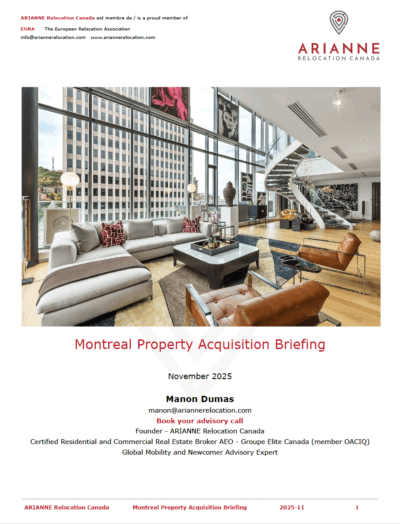
A structured, 44-page executive briefing that brings together the essential local intelligence newcomers and Montreal buyers need before viewing properties. It combines neighbourhood clarity, schooling guidance, market insight, and a clear explanation of the Quebec buying process so you can make informed, confident decisions from the start.
What you will find inside the briefing:
- How the Montreal real estate market works and what makes Quebec different
- A clear framework for understanding the main neighbourhood types and how to compare them
- What different price ranges realistically offer in key areas of the city
- A step-by-step explanation of the Quebec buying process and the documents involved
- An introduction to ownership structures (single-family homes, condos, plexes, and undivided co-ownership)
- Key schooling, lifestyle, and practical considerations that shape neighbourhood choice
- Common pitfalls and blind spots for buyers who are new to the Montreal market
Who this briefing is designed for:
Ideal for newcomers, executives on assignment, interprovincial movers, and Montreal families who want structured, high-quality guidance before entering the market.
Request your Montreal Property Acquisition Briefing
A clear, structured starting point for your Montreal property search.

Speak with Montreal’s Trusted Real Estate & Global Mobility Advisor

Manon Dumas
– Founder and President ARIANNE Relocation Canada
– Certified Residential and Commercial Real Estate Broker with Group Elite Canada
– Holder of Agency Executive Officer qualification
– Member of OACIQ
– Global Mobility and Newcomer Advisory Expert
Independent, high-quality guidance for families, newcomers, and executives navigating Montreal’s real estate market.
Born and raised in Montreal, Manon brings deep knowledge of the city’s neighbourhoods, school systems, and market dynamics. Her international experience across Europe, the United States, and Asia adds a global perspective on what families and executives truly need when choosing the right area and the right property.
For 28 years, she has supported newcomers, executives, and Montreal families through real estate and relocation decisions where long-term value and informed choices matter. As a Certified Residential and Commercial Real Estate Broker (OACIQ) with the advanced Agency Executive Officer (AOE) qualification, she provides strategic guidance grounded in ethics, precision, and decades of local insight. Her professional record is pristine, reflecting a long-standing commitment to rigorous standards and trusted practice.
Manon’s advisory approach integrates neighbourhood analysis, educational system guidance, financing considerations, and long-term value drivers. She works extensively with globally mobile professionals who expect future relocations and need property choices that balance lifestyle, resilience, and resale strength. Her role is to reduce uncertainty, clarify priorities, and help clients move forward with confidence.
This call is for you if you want:
- Expert clarity on Montreal neighbourhoods, value drivers, and long-term market trends
- Guidance that integrates schools, commute patterns, and daily life considerations
- A property strategy aligned with both your goals and your long-term investment
- A faster, more confident start to your Montreal home acquisition process
A clear, expert-led starting point for your Montreal home search.
What makes this mortgage guidance different
Expertise that goes beyond standard online mortgage tools.

Local Financing Intelligence
More than 28 years of hands-on insight into Montreal’s neighbourhoods, property types, financing realities, and the Quebec-specific rules that influence eligibility, down payments, and long-term affordability.

Acquisition & Mortgage Strategy Expertise
Certified Residential and Commercial Real Estate Brokers (OACIQ) with decades advising newcomers and local professionals on complex purchases. We are experienced in navigating residency requirements, lender expectations, and the financing pathways available to Canadian citizens, permanent residents, and work-permit holders.
Newcomer and Global Mobility Perspective
A deep background in real estate, relocation and global mobility that clarifies how residency status, credit history, employment conditions, and expected relocations shape mortgage eligibility and long-term planning. Guidance built for internationally mobile professionals, families, and executives evaluating both lifestyle fit and financial resilience.
Testimonials
Trusted by executives, international families, and professionals seeking clarity, confidence, and expert guidance in Montreal’s real estate market.
“Our move to Canada was our smoothest and happiest of nine relocations thanks to ARIANNE’s professionalism and care.”
Deborah Kemball“ARIANNE made our transition from Germany to Canada smooth, enjoyable, and highly successful.”

Tarik Möröy“The support we received was exceptional. I warmly recommend Manon and ARIANNE as a top-tier provider in their field.”

Anniek Kindts