
CALCULATEUR DE CAPACITÉ D’ACHAT À MONTRÉAL
Vérifiez si l’achat est autorisé dans votre situation et estimez les coûts mensuels totaux de propriété selon un prix donné.
Cet outil applique les règles fédérales canadiennes en vigueur, les lignes directrices de la SCHL et les coûts propres à la propriété à Montréal. Il vous aide à comprendre ce qui est permis et à quoi vous attendre avant de parler à un prêteur.
Aucune inscription requise. Aucune vérification de crédit. Résultats affichés instantanément.
Comment fonctionne le calculateur de capacité d’achat à Montréal
Saisissez quelques informations clés pour vérifier si un scénario d’achat est permis selon les règles en vigueur et pour estimer les coûts mensuels de propriété à un prix donné.
Cet outil est basé sur des scénarios. Il vise à clarifier l’impact des restrictions fédérales, des lignes directrices de la SCHL et des règles propres au Québec sur les options d’achat, notamment lorsque le statut de résidence, l’emplacement et le type de propriété modifient les règles applicables.
Il vous aide à comprendre :
- Si vous êtes légalement admissible à acheter selon votre statut et l’emplacement de la propriété
- Les règles de mise de fonds minimale applicables à votre situation, y compris les exigences liées à l’assurance de la SCHL lorsque pertinent
- Comment les coûts mensuels de propriété peuvent s’additionner à un prix donné, incluant les paiements hypothécaires, les taxes, les frais de copropriété ou d’entretien et l’assurance
- Quelles contraintes structurelles peuvent influencer vos options, comme les RMR restreintes, le type d’occupation, le type de propriété et la structure de propriété
Aucune donnée personnelle requise.
Aucune vérification de crédit.
Important : Ce calculateur n’évalue pas le revenu, les ratios d’endettement, l’historique de crédit ni l’approbation par un prêteur. Un professionnel hypothécaire partenaire de confiance d’ARIANNE ou un prêteur confirmera la capacité d’emprunt et les conditions d’approbation exactes.
Calculateur de capacité d’achat à Montréal
Montreal Mortgage Calculator for Newcomers and Locals
See eligibility requirements. Understand down payment requirements. Estimate monthly costs in under 60 seconds.
No signup required to see the results.
Sources: Calculations and eligibility rules are based on current CMHC guidelines. Regulations can change; speak with a mortgage professional for the latest details. View CMHC website
- Updated for current Canadian mortgage regulations
- Includes non residents and work permits
- Built for Montreal buyers
Immigration Status in Canada
Select the immigration status that applies.
Property Location and Use
These answers help us apply the federal foreign-buyer ban* and lender-specific rules.
*Canada’s federal “Foreign Buyer Ban” is a temporary law until January 1, 2027, restricting non-citizens and non-permanent residents from buying residential properties (houses, condos, townhouses, vacant land under 1 hectare) in urban Census Metropolitan Areas (CMAs) and Census Agglomerations (CAs)—major cities like Montreal, Toronto, Vancouver, etc. Key exemptions include: valid work permit holders (permit valid 183+ days post-purchase, for personal use, one property); international students (similar conditions, price cap under $500K in some cases); permanent residents; protected persons/refugees; spouses/common-law partners of citizens/PRs; and purchases of non-residential or multi-unit properties (e.g., over 3 units, apartments). Rural areas outside CMAs/CAs are exempt; check the CMHC maps on this page for details by region.
Property Price Range
Can be adjusted later in the full view.
Choose a starting price
Typical price in Montreal is between $600,000 and $1,200,000. Choose one now and it can be adjusted later.
Minimum Required Down Payment
Why this result:
Estimated Monthly Housing Cost
Fine-tune Scenario
Property details
Financing
Extra costs
Updated Estimate
Profile & Eligibility
This is an estimate only. A lender will confirm exact numbers.
Includes the assumptions, breakdown, and next steps to buy in Montreal.
Find the best areas that fit budget and lifestyle requirements.
Save Results and unlock Step 2
Enter email address to receive the full mortgage report and access the neighborhood match tool tailored to the budget.
Great. Report is being prepared.
Next, find suitable neighborhoods.
Yes, in certain situations, non-residents and work permit holders may be eligible to purchase property in Montreal. Eligibility depends on legal status, property type, intended use, and location.
Canadian citizens and permanent residents generally have full access to the residential real estate market, subject to standard financing and lender requirements.
For buyers who are not Canadian citizens or permanent residents, including certain work permit holders, study permit holders, and other foreign nationals, eligibility is more nuanced. Federal legislation, including the Prohibition on the Purchase of Residential Property by Non-Canadians Act, introduced restrictions as of January 1, 2023, with specific exemptions and conditions. These rules may affect whether a purchase is permitted, the type of property that can be acquired, and where it may be located, particularly in major metropolitan areas such as Montreal.
In addition to legal eligibility, financing conditions can differ significantly based on buyer profile. Down payment requirements, access to insured mortgages, documentation standards, and lender appetite all vary depending on status and circumstances.
To reflect this reality, the Montreal Buying Power Calculator is built around scenario-based planning and is designed to model purchase scenarios for a wide range of buyer profiles, including:
- Canadian citizens
- Permanent residents of Canada
- Canadian citizens or permanent residents residing abroad
- Status First Nations buyers (persons registered under the Indian Act)
- Refugees or protected persons
- Certain work permit holders who may qualify under the applicable rules
- Certain study permit holders who may qualify under the applicable rules
- Certain foreign nationals, where eligibility may apply under the Prohibition on the Purchase of Residential Property by Non-Canadians Act and its Regulations
Because these rules are complex and continue to evolve, generic mortgage calculators or broad online advice can be misleading. The Montreal Buying Power Calculator provides a structured starting point to explore what may be feasible in Montreal before assumptions are made about affordability, neighbourhoods, or timelines.
The minimum down payment required to buy property in Montreal depends on the purchase price, the type of property, and the buyer's eligibility under Canadian mortgage and housing rules.
At the federal level, Canada applies standardized minimum down payment rules for eligible residential purchases:
- 5% on the first $500,000 of the purchase price
- 10% on the portion of the purchase price from $500,000 up to $1.5M (the maximum insured price point)
- For properties priced at $1.5M or more, a minimum 20% down payment is required. Mortgage default insurance is not available at this price point.
Purchases made with less than 20% down generally require mortgage default insurance (CMHC, Sagen, or Canada Guaranty), subject to eligibility. With 20% or more down, insurance is not required and lenders may offer a broader range of products and terms.
In practice, required down payments in Montreal can be higher than the federal minimums. Down payment expectations often change based on the buyer profile, the lender, and the property.
- Legal or residency status in Canada (for example, some temporary residents or eligible foreign buyers may be asked for 20% to 35% or more by certain lenders)
- Access to insured versus uninsured mortgage programs (and whether the purchase qualifies for CMHC or similar coverage)
- Individual lender policies and risk assessment
- Income structure, documentation, and credit history (Canadian and foreign)
- Property type (e.g., condo vs. plex) and intended use (owner-occupied vs. rental)
Canadian citizens and permanent residents who meet standard income and credit requirements typically qualify closer to the federal minimums. Other profiles may face higher equity requirements, additional documentation, or fewer lender options depending on eligibility and lender policy.
Because of these variables, relying solely on generic online calculators or headline minimums can be misleading. The Montreal Buying Power Calculator is designed to model different down payment scenarios across buyer profiles and price ranges, helping to build a realistic planning framework before significant time is invested in neighbourhood or property searches that may not align with actual financing options.
In Canada, a mortgage is a loan used to purchase real estate (a house, condo, or other residential property). The property serves as security for the loan, and it is repaid over time through regular payments that include principal and interest.
The mortgage stress test is a federal qualifying rule used by most major lenders. It requires buyers to qualify at a higher interest rate than the rate offered, to ensure payments remain affordable if rates rise.
Under current rules, the qualifying rate is the higher of:
- 5.25%, or
- the lender's offered mortgage rate plus 2%
Example: if the lender offers 4.5%, qualification is calculated at 6.5%. Affordability is tested at 6.5%, even though payments are based on 4.5%.
The stress test generally applies to:
- Insured mortgages (less than 20% down)
- Uninsured mortgages obtained through federally regulated lenders (for example, major banks)
Straight renewals without increased borrowing are generally exempt. Qualification rules can vary with some credit unions and private lenders.
In practice, the stress test often reduces maximum borrowing capacity by roughly 15% to 20%. In Montreal, that difference can materially change neighbourhood and property options.
Understanding the stress test early helps buyers avoid targeting properties outside realistic qualification limits and align search criteria with true buying power.
Official guidance is published by the Office of the Superintendent of Financial Institutions (OSFI).
The Montreal Buying Power Calculator is a planning tool focused on monthly ownership costs and scenario budgeting. It does not provide lender approval.
The calculator establishes a planning framework. Translating that framework into the right neighbourhood and property type requires local market context, which is where advisory guidance becomes essential.
ARIANNE supports buyers at this stage by helping structure a realistic purchase plan and connecting financing assumptions to neighbourhood strategy before property visits begin.
The Welcome Tax, officially known as property transfer duties, is a one-time municipal tax payable by the buyer when a property is purchased in Montreal. It is required for all residential property transfers and is paid to the City of Montreal after closing.
The tax is calculated on the highest of the following three amounts:
- The purchase price
- The amount stated in the deed of sale
- The municipal evaluation value, adjusted by the comparative factor in effect
Montreal Welcome Tax Rates (2025)
Montreal applies a progressive rate structure, meaning different portions of the purchase price are taxed at different rates:
- 0.5% on the first $61,500
- 1.0% on the portion from $61,500 to $307,800
- 1.5% on the portion from $307,800 to $552,300
- 2.0% on the portion from $552,300 to $1,104,700
- 2.5% on the portion from $1,104,700 to $2,136,500
- 3.5% on the portion from $2,136,500 to $3,113,000
- 4.0% on any amount above $3,113,000
Example: $1,000,000 Property in Montreal
- $61,500 × 0.5% = $307.50
- $246,300 × 1.0% = $2,463.00
- $244,500 × 1.5% = $3,667.50
- $447,700 × 2.0% = $8,954.00
- Total Welcome Tax: $15,392.00
This amount is paid by the buyer and is not included in the mortgage.
When and how is the Welcome Tax paid?
- The notary registers the property transfer at closing
- The City of Montreal sends an invoice approximately 4 to 6 weeks after closing
- Payment is due within 30 days of the invoice date
- Late payment results in interest and penalties
Are there rebates or exemptions?
In some cases, first-time buyers may qualify for partial rebates, particularly when purchasing a primary residence and having a dependent child under 18. Eligibility criteria and rebate amounts vary and must be confirmed directly with the City of Montreal.
Official information is published by the City of Montreal: https://montreal.ca/en/topics/taxes-new-homeowners
Why this matters for buyers:
The Welcome Tax is often one of the largest acquisition costs when buying property in Montreal and must be planned for in cash, in addition to the down payment and other closing costs.
When buying a property in Montreal, buyers must plan for closing and acquisition costs in addition to the down payment. These are mostly one-time costs that are not fully reflected in monthly affordability calculations and vary based on property type, purchase price, and individual circumstances.
The Montreal Buying Power Calculator focuses primarily on estimating monthly housing costs and purchase scenarios, such as mortgage payments and, where applicable, municipal taxes, school taxes, condominium fees, maintenance allowances, and insurance assumptions. Closing costs should therefore be budgeted separately.
Typical closing and acquisition costs in Montreal include:
- Pre-purchase property inspection and related expert reports
- Appraisal fees, if required by the lender
- Legal and notary fees
- Title insurance, where applicable
- Adjustments for municipal taxes, school taxes, and other prepaid expenses
- Tax on the mortgage insurance, where applicable
- GST and QST, notably on new construction or other taxable properties
- Property transfer duties, commonly known as the Welcome Tax
- Moving costs
- Initial setup costs such as utilities, appliances, or furnishings
- Immediately required repairs or improvements
In Montreal, property transfer duties are calculated on a progressive scale based on the purchase price and are payable to the city after the transaction. Official rates and details are published by the City of Montreal.
How much should buyers budget?
As a general planning benchmark, buyers in Montreal often budget approximately 4.5% to 5.5% of the purchase price in cash for closing and acquisition costs on resale properties, excluding any financed mortgage insurance costs. Actual costs vary depending on the property and the buyer's situation.
How closing costs differ by property type:
Single-family home (e.g. Plateau-Mont-Royal)
A house purchase typically includes Welcome Tax, notary and legal fees, inspection costs, possible appraisal fees, tax adjustments, moving costs, and higher ongoing maintenance responsibilities. While there are no condominium fees, maintenance and repair expenses should be planned for.
High-rise condominium with amenities (e.g. downtown Montreal)
A condominium purchase includes Welcome Tax, notary and legal fees, inspection and possible appraisal costs, tax adjustments, and monthly condominium fees covering shared amenities, building staff, and long-term maintenance funds. Insurance structures also differ from those of a house.
For buyers who want a fully detailed acquisition cost scenario, including verified estimates tailored to a specific price range and property type, ARIANNE provides structured planning support as part of its advisory services.
Yes. In Quebec, a notary (notaire) is required to complete a residential real estate transaction. The deed of sale must be executed in notarial form and registered at the Land Registry.
This differs from other Canadian provinces, where real estate transactions are typically completed by lawyers.
Why a notary is required in Quebec:
Under Quebec law, only a licensed notary is authorized to:
- Prepare and authenticate the deed of sale (acte de vente)
- Conduct the title search and verify ownership
- Ensure there are no liens, mortgages, or legal encumbrances affecting the property
- Register the transfer at the Land Registry and ensure the legal documents are properly filed (the City of Montreal later issues the property transfer duties invoice to the buyer).
Notaries in Quebec act as neutral public officers. They do not represent one side the way lawyers often do in other provinces. Their role is to ensure the transaction is legally valid and properly registered.
Can a lawyer replace a notary in Quebec?
No. Lawyers in Quebec cannot prepare, authenticate, or register a deed of sale for residential property. Lawyers may advise on contracts, review a promise to purchase, or assist with disputes. However, the deed of sale itself must be prepared and executed by a notary.
Cost and timing:
Notary fees for a residential purchase in Montreal commonly range from about $1,000 to $2,500+, depending on the transaction.
It is recommended to select a notary early, ideally when or before a promise to purchase is being prepared, to allow time for due diligence and document preparation.
Language of the deed of sale in Quebec (2025):
- in practice, deeds are commonly prepared in French. Some notaries can provide an English or bilingual version for review when parties request it, but registration requirements and wording should be confirmed with the notary for the specific file.
- An English deed is permitted only if both buyer and seller expressly request it
- For registration at the Land Registry, a certified French translation is required
- This can add additional costs (often $500–$1,500) and processing delays of several weeks
Many Montreal notaries offer services in both French and English, which is helpful for newcomers and interprovincial buyers.
Why this matters for buyers:
Understanding Quebec's notarial system early helps buyers:
- Avoid surprises late in the transaction
- Budget accurately for closing costs
- Plan timelines realistically
- Ensure compliance with provincial and federal rules
This is particularly important for buyers relocating from other provinces or from abroad, where the legal process differs significantly.
Property prices in Montreal vary widely by neighbourhood and property type, with the highest values concentrated in central and established areas.
Buyers researching average condo prices in Montreal or average house prices in Montreal should be aware that published averages often differ significantly from what is achievable in central neighbourhoods, where demand, scarcity, and lifestyle factors drive higher pricing.
As a general reference point, APCIQ / Centris reported the following median prices for the Greater Montreal Census Metropolitan Area (CMA) in November 2025:
- Single-family homes: approximately $635,000
- Condominiums: approximately $425,000
- Plexes (2 to 5 units): approximately $855,000
These figures are often cited online as Montreal home prices, but they reflect the entire metropolitan area, including outer suburbs. They do not represent pricing in central Montreal neighbourhoods, where most buyers focus.
Typical condo and house price ranges in central Montreal (late 2025)
Condominiums (central Montreal):
In neighbourhoods such as Ville-Marie, Sud-Ouest, Plateau-Mont-Royal, Verdun, and Île-des-Soeurs, condominium pricing varies widely depending on building type, age, and amenities.
- Resale and low-rise condos in well-located buildings often trade in the $550,000 to $750,000 range for one- and two-bedroom units, depending on micro-location and building quality.
- Larger units, newer construction, or renovated buildings commonly fall between $750,000 and $900,000+.
- High-rise condominiums in downtown Ville-Marie, particularly those offering amenities such as gyms, pools, concierge services, security, or indoor parking, frequently range from $700,000 to $1M+, depending on unit size and views.
Monthly condominium fees, special assessments, parking, storage, and proximity to transit can materially affect both purchase price and total monthly ownership costs.
Single-family homes and townhouses:
- In high-demand neighbourhoods such as Plateau Mont-Royal, Rosemont, Verdun, NDG, and parts of the Sud-Ouest, family homes typically range from $900,000 to $1.5M+.
- In premium neighbourhoods such as Outremont, Ville-Mont-Royal (TMR), and Westmount, prices frequently range from $1.5M to $2.5M+ for family homes.
- Townhouses and semi-detached homes in central areas commonly fall between $900,000 and $1.4M+, depending on condition and location.
Duplexes and triplexes (plexes)
- In central Montreal, plex properties are priced at a premium due to land value and rental potential.
- Duplexes and triplexes commonly range from $900,000 to $1.6M+.
- Pricing depends heavily on location, condition, zoning, rental income, and whether units are vacant or occupied.
Why price ranges matter more than averages:
Published averages and medians often mask reality in Montreal. Two properties at the same price point can offer very different outcomes depending on neighbourhood, renovation level, monthly ownership costs, and competition at that price level.
The Montreal Buying Power Calculator helps buyers understand realistic monthly ownership costs and explore purchase scenarios. From there, ARIANNE is available to help turn those scenarios into a clear, structured acquisition plan by aligning budget comfort, neighbourhood options, property types, and timing. This allows buyers to move forward with clarity and peace of mind before engaging lenders or visiting properties.
For first-time buyers purchasing in central Montreal, neighbourhood choice is less about finding the cheapest option and more about balancing price, lifestyle, transit access, and long-term value.
As of late 2025, most first-time buyers in central areas are entering the market in the $600,000 to $900,000 range, depending on property type and condition.
Neighbourhoods frequently considered by first-time buyers:
Verdun
- Strong metro access, waterfront, and vibrant local life
- Mix of older condos, plex conversions, and small houses
- Typical condo pricing: $550,000 to $800,000+
- Popular with professionals and young families
Rosemont–La Petite-Patrie
- Excellent walkability, parks, schools, and transit
- Wide range of condo sizes and plex-style properties
- Typical condo pricing: $600,000 to $850,000+
- Strong long-term demand and resale value
Sud-Ouest (including Saint-Henri, Little Burgundy and Griffintown edges)
- Central location with easy downtown access
- Renovated condos and townhouses common
- Typical pricing: $600,000 to $900,000+
- Popular for first-time buyers seeking urban lifestyle
NDG (Notre-Dame-de-Grâce)
- Family-oriented neighbourhood with good schools and parks
- Larger units and duplex-style properties
- Condos and entry-level homes often start around $800,000+
- Attractive for buyers planning to stay longer term
Ville-Marie (select sectors)
- Downtown living close to employment hubs
- Newer high-rise condos with amenities
- Pricing varies widely, often $650,000 to $1M+
- Monthly condo fees must be factored carefully
Important planning considerations for first-time buyers:
In Montreal, neighbourhood choice should be guided by more than purchase price alone. Buyers benefit from evaluating:
- Monthly ownership costs, not just price
- Transit access and commute patterns
- School catchment areas, where relevant
- Building condition and condominium fees
- Competition levels at different price brackets
Many first-time buyers discover that a slightly lower purchase price in the right neighbourhood provides greater comfort, flexibility, and long-term satisfaction than stretching to the maximum possible price.
The Montreal Buying Power Calculator helps buyers understand realistic monthly cost scenarios. From there, ARIANNE can help translate those scenarios into a neighbourhood strategy and acquisition plan aligned with lifestyle priorities and long-term goals.
For many families relocating to or moving within Montreal, school choice is one of the most important factors influencing where to live, often even before budget calculations or property searches begin.
In Quebec, schooling is governed by a unique and highly regulated system that directly affects neighbourhood choice, housing options, and long-term planning. As a result, school considerations are closely linked to real estate decisions and should be addressed before the buying process begins.
Why school planning in Montreal is complex:
Montreal's education system includes multiple overlapping pathways, including:
- French-language public schools, which are the default under Quebec law
- Welcome classes for newcomers learning French
- English-language public and private schools, which are accessible only to students who meet strict eligibility criteria
- Government-subsidized private schools
- Non-subsidized private schools
- Religious and specialized programs
Access depends on factors such as:
- Language eligibility under Quebec law
- Immigration status and timing
- School catchment zones
- Entrance exams and application deadlines
- Availability of places in a given year
For many highly regarded public high schools, entrance exams and applications must be completed up to a year in advance, often requiring the child to already be in Montreal with valid status. This makes access almost impossible for newcomers to Canada to access in their first year.
Why this matters when using the Mortgage Calculator:
Because school options are tied to specific neighbourhoods and zones, they directly influence:
- Which areas are best and realistic to consider
- Property types available within those areas
- Price ranges and monthly ownership costs
Many families make the mistake of calculating affordability first, only to discover later that the neighbourhoods they can afford do not align with their schooling priorities.
How ARIANNE supports buyers:
The Montreal Buying Power Calculator helps establish monthly cost scenarios. ARIANNE complements this by providing school advisory services, helping families understand:
- Which neighbourhoods align with their schooling goals
- What is realistic in the first year versus future years
- How school planning and housing strategy should be coordinated
This integrated approach allows families to make informed decisions with clarity and peace of mind, before committing to a purchase or narrowing their property search.
The next step is to place the scenario in context.
After using the Montreal Buying Power Calculator, buyers typically have a clearer understanding of potential price ranges, estimated monthly costs, and high-level constraints. What remains is to confirm how those assumptions align with current market conditions, neighbourhood realities, legal considerations, and lender expectations in Montreal.
At this stage, a structured advisory review helps:
- Confirm that the planning scenario is realistic and financeable
- Align budget assumptions with neighbourhood pricing and availability
- Clarify acquisition and closing cost implications
- Identify constraints related to legal status, timing, or property type
- Refine the purchase strategy before engaging lenders or visiting properties
This review is particularly valuable before:
- Contacting real estate brokers
- Scheduling property visits
- Making offers or commitments
- Coordinating relocation, schooling, or family timelines
ARIANNE's role is to help buyers move from planning to execution with clarity, structure, and confidence. This ensures that time and effort are focused on options that are realistic, aligned, and appropriate.
From there, buyers can proceed efficiently with the right professionals, whether that involves mortgage brokers (licence holders AMF), real estate brokers (license holders OACIQ), or other specialists, based on a well-informed and coherent plan.
Disclaimer:
This calculator is for illustrative purposes only. Users should not rely on this calculator to make any financial decisions. While every effort is made to keep this tool up-to-date, ARIANNE Relocation Canada does not guarantee the accuracy, reliability or completeness of any information or calculations provided by this calculator. ARIANNE Relocation Canada is not liable for loss or damage of any kind arising from the use of this tool.
Guide stratégique d’achat immobilier à Montréal
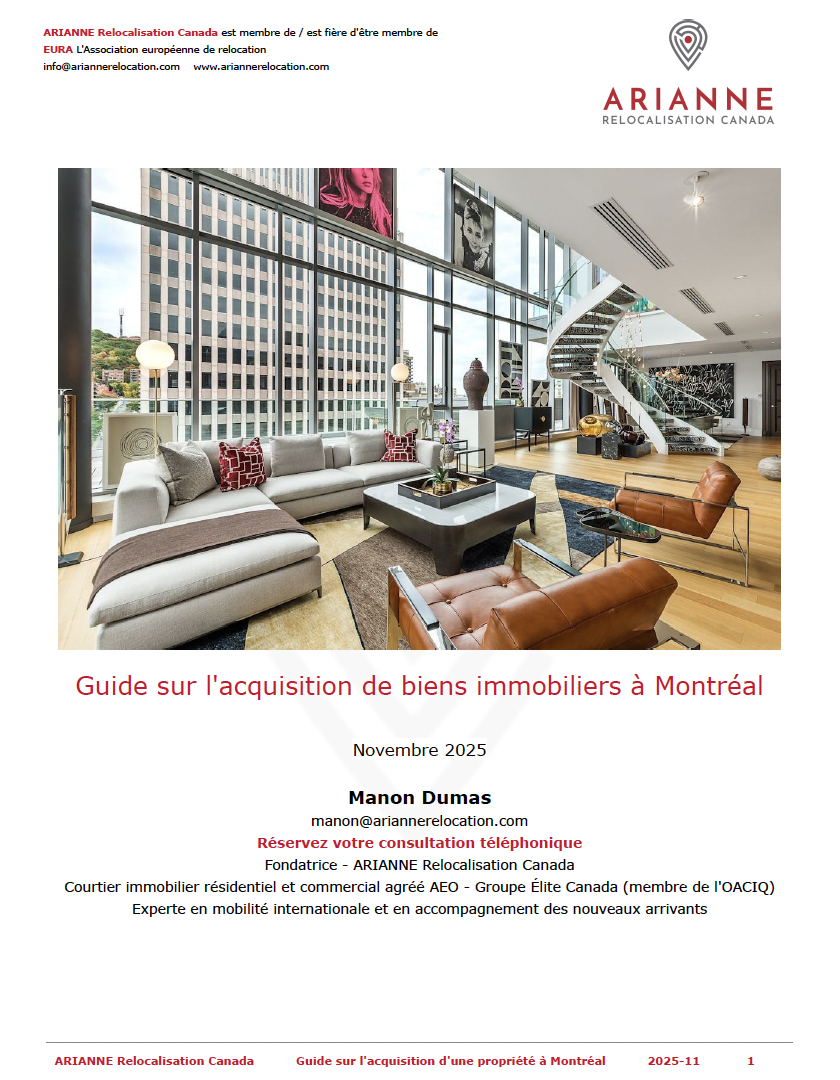
Un guide exécutif structuré de 49 pages qui rassemble l’intelligence locale essentielle dont les nouveaux arrivants et les acheteurs à Montréal ont besoin avant de visiter des propriétés. Il combine une lecture claire des quartiers, des repères scolaires, une analyse du marché et une explication structurée du processus d’achat au Québec, afin de vous permettre de prendre des décisions éclairées et confiantes dès le départ.
Ce que vous trouverez dans le guide :
- Le fonctionnement du marché immobilier montréalais et ce qui distingue le Québec
- Un cadre clair pour comprendre les principaux types de quartiers et apprendre à les comparer
- Ce que les différentes fourchettes de prix offrent de façon réaliste dans les secteurs clés de la ville
- Une explication étape par étape du processus d’achat au Québec et des documents requis
- Une introduction aux structures de propriété (maisons unifamiliales, copropriétés, plex et copropriété indivise)
- Les considérations scolaires, de style de vie et pratiques qui influencent le choix d’un quartier
- Les pièges courants et les angles morts fréquents chez les acheteurs nouveaux sur le marché montréalais
À qui s’adresse ce guide :
Idéal pour les nouveaux arrivants, les cadres en affectation, les acheteurs provenant d’autres provinces et les familles montréalaises qui souhaitent bénéficier d’un accompagnement structuré et de grande qualité avant d’entrer sur le marché.
Téléchargez le guide d’acquisition immobilière à Montréal
Un point de départ clair et structuré pour votre recherche immobilière à Montréal.

Accédez à l’expertise d’une conseillère reconnue en immobilier et mobilité internationale à Montréal

Manon Dumas
– Fondatrice et présidente ARIANNE Relocalisation Canada
– Courtier immobilier résidentiel et commercial agréé DA – Group Élite Canada
– Détentrice de la qualification de dirigeant d’agence
– Membre de l’OACIQ
– Spécialiste en mobilité internationale et en accompagnement des nouveaux arrivants
Un accompagnement indépendant et de grande qualité pour les familles, les nouveaux arrivants et les cadres qui naviguent le marché immobilier montréalais.
Née à Montréal, Manon possède une connaissance approfondie des quartiers de la ville, des systèmes scolaires et des dynamiques du marché immobilier. Son expérience internationale en Europe, aux États-Unis et en Asie lui apporte une perspective globale sur ce dont les familles et les cadres ont réellement besoin lorsqu’il s’agit de choisir le bon secteur et la bonne propriété.
Depuis 28 ans, elle accompagne des nouveaux arrivants, des cadres et des familles montréalaises dans des décisions immobilières et de relocalisation où la valeur à long terme et la qualité des choix sont déterminantes. Courtière immobilière agréée en immobilier résidentiel et commercial, membre de l’OACIQ, et titulaire de la qualification avancée de dirigeante d’agence (DA), elle offre un accompagnement stratégique fondé sur l’éthique, la rigueur et des décennies d’expertise locale. Son dossier professionnel est irréprochable et témoigne d’un engagement constant envers des standards élevés et une pratique digne de confiance.
L’approche conseil de Manon intègre l’analyse des quartiers, l’orientation dans les systèmes scolaires, les considérations de financement et les facteurs de valeur à long terme. Elle travaille étroitement avec des professionnels à mobilité internationale qui anticipent de futures relocalisations et dont les choix immobiliers doivent concilier qualité de vie, résilience et potentiel de revente. Son rôle est de réduire l’incertitude, de clarifier les priorités et d’aider ses clients à avancer avec confiance.
Cet appel s’adresse à vous si vous recherchez :
- Une lecture experte des quartiers de Montréal, des facteurs de valeur et des tendances de marché à long terme
- Un accompagnement qui intègre les écoles, les trajets quotidiens et les réalités de la vie de tous les jours
- Une stratégie immobilière alignée à la fois sur vos objectifs personnels et votre investissement à long terme
- Un démarrage plus rapide et plus assuré de votre processus d’acquisition à Montréal
Un point de départ clair, structuré et guidé par l’expertise pour votre recherche immobilière à Montréal.
Une approche hypothécaire qui se démarque
Une expertise qui va au-delà des outils hypothécaires en ligne standards

Maîtrise des réalités de financement locales
Plus de 28 ans d’expertise terrain au cœur de Montréal, pour comprendre les quartiers, les types de propriétés et les règles de financement qui déterminent votre capacité d’achat à long terme.

Expertise acquisition & stratégie hypothécaire
Courtiers immobiliers agréés OACIQ, experts des acquisitions complexes pour nouveaux arrivants et professionnels, avec une maîtrise des statuts de résidence et des options de financement.
Perspective mobilité internationale & nouveaux arrivants
Une solide expertise en immobilier, en relocalisation et en mobilité internationale qui permet de comprendre comment le statut de résidence, l’historique de crédit, les conditions d’emploi et les relocalisations anticipées influencent l’admissibilité hypothécaire et la planification à long terme. Un accompagnement conçu pour les professionnels, les familles et les cadres à mobilité internationale qui évaluent à la fois l’adéquation du mode de vie et la résilience financière.
Témoignages
Choisie par ceux qui recherchent clarté, confiance et expertise pour acheter à Montréal.
« De nos neuf relocalisations, notre arrivée au Canada a été la plus fluide et la plus réussie, grâce à l’accompagnement d’ARIANNE. »
Deborah Kemball« Grâce à ARIANNE, notre transition de l’Allemagne vers le Canada s’est déroulée avec fluidité, plaisir et succès. »

Tarik Möröy« L’accompagnement reçu a été remarquable. Je recommande sans hésitation Manon et ARIANNE comme des références dans leur domaine. »

Anniek Kindts